3. I don't want to be pushed around by my thoughts and feelings anymore. What can I do?
Unhooking Exercises
a. Learning to notice the difference between descriptions and evaluations.
Learning to unhook from thoughts takes practice. One excellent practice involves distinguishing between descriptions and evaluations.
A description is a thought that refers to things you can see, hear, smell, taste, or touch--something that you can actually physically sense with one of your five senses. If you were to describe the cup below, you would say that it is white, hard, and maybe cold to the touch
An evaluation is a thought that refers to the importance of something
(I am not important), the goodness or badness of something (I must be or have done something bad), and the usefulness of something (I am useless, what is the point).
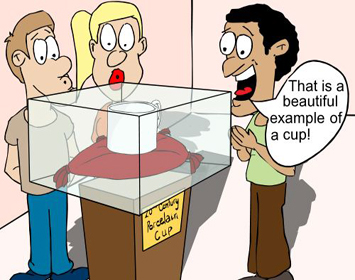
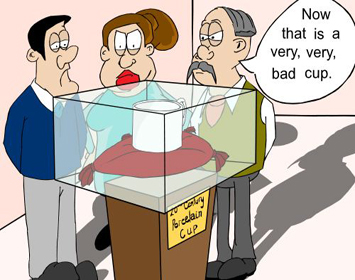
In the above images, the evaluations refer to how "good" or "bad" the cup is.
We often get ourselves into trouble by confusing descriptions and evaluations. We often think evaluations are as solid as prison bars, or as dangerous as real threats.
But notice in the above example the difference between the description (the cup is white) and the evaluation. The evaluation is nowhere in the cup. It occurs in our own head. The whole world could believe the cup was bad, and it would still be exactly the same cup. It would still be white. The whole world could believe the cup was good, and still it would not change.
So there is something a little fishy about evaluations. They are not as substantial as descriptions. They might be helpful sometimes. Other times they might not be helpful.
We can choose to "follow the advice" of evaluations, if useful.
Or we can choose to hear them, not buy into them, and carry them with us as we get on with what is important to us.
Please try the description-evaluation exercise. This exercise will help you to relate what we are saying here to your own life.
Exercise: Descriptions and evaluations
When you have finished this exercise, please try the following two. They will help you to look at your thoughts and feelings in some new and very important ways.
Exercise: Learning to look at your experiences in a new way
Exercise. The tin can monster (Audio)
 
|